Showing posts with label yugoslavia. Show all posts

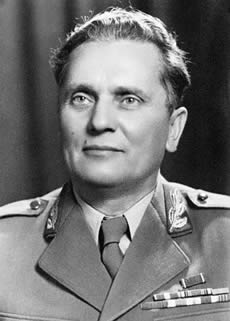
Marshal Tito (Josip Broz)

Josip Broz was born on May 7, 1892, and died on May 4, 1980. His life was caught up in some of the most momentous events of the 20th century. He fought in World War I, took part in the Russian Revolution, became a leader of guerrilla resistance to the German occupation of Yugoslavia, and after World War II until his death he was the leader of the country.

During this period, he defied Joseph Stalin over the communist consolidation of power in Yugoslavia. "Tito" was a pseudonym that he adopted during his underground activities, and it was with this name that he became well known during World War II.

Tito was born in the village of Kumroves, some 50 kilometers northwest of Zagreb in what was then Austria-Hungary. His native village is located in the valley of the river Sutla, which served as a boundary between Croatia and Slovenia. Tito’s father was a Croatian peasant, and his mother was Slovenian from a village across the river.

In 1907, at the age of 15, he left home and went to the town of Sisak (Croatia), where he became an apprentice to a locksmith. Tito completed his apprenticeship in 1910 and began a series of mechanic jobs, which took him to factories across central Europe.


In the autumn of 1913 Tito was called up for his military service, which he did with the 25th Croatian Territorial Infantry Regiment based in Zagreb. When Austria-Hungary attacked Serbia in July 1914, Tito, already a sergeant, was sent to fight on the Serbian front.

In January 1915 his regiment was transferred to Galicia in anticipation of a Russian offensive. There Tito was put in charge of a reconnoitering section operating behind enemy lines. However, during a Russian attack in April 1915, he was seriously wounded and taken as a prisoner of war (POW).

It was during this time that Tito began sympathizing with the ideas of Bolshevism. In June 1917 he escaped from the POW camp and made his way to Petrograd in search of work, but the suppression of Bolshevik demonstrations forced him to flee to Finland.

While attempting to cross the border he was captured and sent back to the POW camp, but he escaped on the way and arrived in Bolshevik-controlled Omsk in Siberia in autumn 1917. He enrolled in the Red Guard and applied for membership in the Communist Party.

Marshal Tito and Winston Churchill in 1944 in Naples, Italy

When the Bolsheviks retook Omsk in 1919, he started making his way back to Croatia. Tito returned to Kumrovec in October 1920, where he found that his village had become part of the new Kingdom of Serbs, Croats, and Slovenes (changed to Yugoslavia in 1929).

Upon his return he joined the newly founded Communist Party in Zagreb and became active in the union movement. During the 1920s he worked as a mechanic in factories across Yugoslavia. In 1927 he became secretary of the Metalworkers’ Union of Croatia.

His activities brought him to the attention of the police, and in August 1928 he was arrested. Upon his release from prison in 1934 Tito resumed full-time clandestine activities for the Yugoslav Communist Party.

In February 1935 he was sent to Moscow for training with the Balkan Department of the Comintern. He stayed there until September 1936, when he was sent back to consolidate the Yugoslav party and recruit volunteers to fight in the Spanish civil war.

During 1937 the factionalism within the Yugoslav Communist Party increased, and in the atmosphere of uncertainty Tito asserted his authority by setting up an interim secretariat under his leadership. Moscow offered him provisional approval in the beginning of 1939, and Tito was officially confirmed as a secretary at a party congress in October 1940.

In April of 1941 the Axis powers invaded, occupied, and partitioned Yugoslavia, which triggered a civil war in the country. Tito formed the Partisan Army of National Liberation, which waged guerrilla war against the occupying forces. In the process Tito’s partisans also turned against rival guerrilla organizations, in particular the internationally recognized "Chetniks" of Draža Mihailovic´.

Tito and his partisans emerged victorious from the war, and, despite his promises to form a government of national unity, he immediately began consolidating his authority and establishing communist rule over the territory of Yugoslavia.

At the same time Tito was entertaining ideas of leading a Balkan federation involving Albania, Bulgaria, and potentially Greece. The prospect of a regional federation under Tito’s leadership seemed likely during 1947 and brought Tito into a direct confrontation with Stalin.

In 1948 the Yugoslav Communist Party was excluded from the Cominform (the postwar name for the Comintern), and this turned Tito into the first communist leader to break with the Soviet Union. This gave him both new international prominence and domestic appeal, which helped him consolidate his position in Yugoslavia.

In domestic affairs Tito promoted the principles of brotherhood and workers’ self-management (a form of market-oriented socialism), in parallel with his ongoing suppression of internal dissent.

His death in 1980 was a shock for the country, and the seeming stability of Yugoslavia began to crack under the strains of national factionalism. Many commentators trace the origins of the 1990s Yugoslav dissolution to Tito’s authoritarian rule.

Breakup and War in Yugoslavia

Breakup and War in Yugoslavia

The wars that attended the breakup of Yugoslavia during the 1990s tend to be explained by indicating some historical predisposition of Balkan nationalities toward violence against one another.

Although the legacy of the past did play a role in the conflict, it did not determine the bloodshed. In this respect there is no single reason for the dissolution of the Socialist Federated Republic of Yugoslavia. Instead, there is a complex array of economic, cultural, and systemic factors.

Many of these factors can be traced to the federal design imposed on the state by Marshal Tito (Josip Broz), which began to unravel soon after his death. The April 1981 Albanian riots in Kosovo marked a turning point in the history of the Yugoslav state, which saw an escalation in interethnic tensions during the 1980s.


These were underpinned by regional economic disparities. Gradually, economic nationalism impacted political developments. The ethnically based structure of the federation ensured that the political elites of individual republics relied on the support of their respective republics. Political programs, therefore, were increasingly influenced by nationalist agendas.

Slobodan Milosevic

These developments would not have sufficed to take Yugoslavia down the path of intercommunal violence had it not been for the agency of individual republican leaders. Most commentators agree that it was the rise to power in Serbia of Slobodan Miloševic that led to war.

His manipulation of Serb nationalist sentiments allowed him to become president of Serbia in 1989. Under Miloševic’s leadership the Serbian parliament amended the constitution of the republic in March 1989. The provinces of Kosovo and Vojvodina lost their autonomy.

In December 1990 Miloševic´ ordered the National Bank of Yugoslavia to allocate unauthorized credits to Serbian-owned enterprises, which both triggered hyperinflation and stiffened the resolve of other republics to secede from Yugoslavia. Miloševic’s chauvinistic rhetoric and policies pushed the country into war.

Slobodan Milosevic
Slobodan Milosevic

From April to December 1990 all republics held multiparty elections. The overall success of nationalist formations at the ballot box precipitated the impasse that Yugoslavia reached in 1991. In October 1990 Slovenia and Croatia tabled a formal proposal for the transformation of Yugoslavia into a loose confederation. Miloševic´ rejected it.

The crisis came in spring 1991 when Serbia announced that it was going to block the rotation of the federal presidency. In May 1991 the Serb representative refused to step down, which forced Slovenia and Croatia to declare independence on June 25, 1991, starting a series of wars.

The shortest of those conflicts was the so-called 10-day war in Slovenia. It started on June 27, 1991, when units of the Yugoslav People’s Army (JNA) crossed into Slovenia from Croatia, and JNA units around Ljubljana moved in to occupy the airport.


Yet what the authorities in Belgrade did not anticipate was the resolve of the fledgling Slovenian army and Slovenian citizens. By deploying effectively, Slovenian detachments engaged in attacks and ambushes of JNA convoys, besieged JNA barracks, and blocked roads.

On July 5 the two sides agreed to a cease-fire, and on July 7, 1991, under the auspices of the European Community, the heads of Yugoslavia’s republics signed the Brioni Agreement, which allowed for Slovenia’s independence.

The Brioni Agreement, however, did not address the situation in Croatia. In February 1991 there were skirmishes between Croatian police and Serb militias. In April 1991 the self-proclaimed Serbian Autonomous Region of Krajina declared its secession from Croatia.

By June, fighting in this area had already begun. JNA forces retreating from Slovenia lent their support to Serb militias, and in July 1991 a full-fledged war began in Croatia. The JNA attack targeted towns across Croatia.

The city of Vukovar in particular became a symbol of the barbarity of the war. Completely surrounded by Serb forces in August, it was under siege for nearly 90 days, by the end of which the entire town was leveled.

Ethnic Cleansing

The war in Croatia witnessed the first instances of "ethnic cleansing"—a policy for "clearing" a particular territory of rival ethnic groups by either killing or expelling them. In October 1991, JNA forces began bombing the old city of Dubrovnik on the Dalmatian coast.

This marked a turning point in the wars of Yugoslav dissolution as it urged international actors to get involved in stopping the violence. In late November all sides to the conflict agreed to a cease-fire, which was brokered by the United Nations (UN).

The truce allowed for the establishment of a United Nations Protection Force (UNPROFOR). This ended the first phase of the war in Croatia. The cease-fire held from 1992 to 1994. In May 1995 the Croatian army took the offensive again, starting the second phase of the war, and retook most of the Serb-controlled areas in western Slavonia and in the region of Krajina. This triggered an exodus of almost all the Serbs who lived in the country. The war in Croatia ended in December 1995.

In many respects the fighting in Croatia marked the next stage in the dissolution of Yugoslavia—the attempt to carve ethnically homogeneous states. On December 19, 1991, the Serbian-controlled western Slavonia and the region of Krajina declared themselves the Republic of Serbian Krajina, and on December 26, 1991, the government in Belgrade declared the establishment of the Federal Republic of Yugoslavia, consisting of Serbia, Montenegro, and Serbian Krajina. This formation attested to Miloševi´c’s strategy of carving out a "Greater Serbia" under the guise of a smaller Yugoslavia.

This approach was tragically confirmed during the war in Bosnia-Herzegovina. The republic was one of the most ethnically heterogeneous in former Yugoslavia. In 1990 the JNA had already begun transferring weapons to Serb militias in Bosnia-Herzegovina.

In August 1991 Miloševic´ met with the Bosnian Serb leader Radovan Karadžic´ to discuss a strategy for annexing portions of the republic to Serbia. In September the JNA began establishing, securing, and arming Serbian areas in Bosnia-Herzegovina, which in January 1992 proclaimed themselves the Republika Srpska (Serbian Republic).

At the same time, the Croatian president Franjo Tudjman was also plotting to annex the Croat-dominated areas of Bosnia-Herzegovina. Despite the ongoing fighting between Serbia and Croatia, Miloševic´ and Tudjman met secretly in September 1991 to discuss the division of Bosnia-Herzegovina.

The war in Bosnia-Herzegovina began in April 1992. The initial stages saw Serbian forces confronting Bosniaks and Herzegovinian Croats. The Serb forces unleashed a campaign of ethnic cleansing. In response to the violence, the United Nations designated as "safe areas" the cities of Sarajevo, Bihac´, Gorazde, Srebrenica, Tuzla, and Zepa; dispatched UNPROFOR troops; and declared Bosnia-Herzegovina a no-fly zone.

The international community presented a peace plan in January 1993 that proposed the division of the country between the Serbs, the Croats, and the Bosniaks. This proposal was rejected. Fighting continued until March 1994, when the Bosniaks and Croats formed a Bosniak-Croat Federation of Bosnia-Herzegovina.

Another front line was opened between the Bosniak forces themselves. The confrontation started in 1993 and went on until 1995. The intensity of the fighting in Bosnia-Herzegovina, and in particular the massacre of 7,000 Bosniak men and boys as a result of the capture of the "safe area" of Srebrenica by Bosnian Serb forces, urged the international community to act. During November 1995 all sides met in Dayton and negotiated a peace agreement, which ended the war in Bosnia-Herzegovina.

In his first act as president of Serbia in 1989, Miloševic´ had revoked the autonomy of Kosovo. This exacerbated the tensions between the Kosovo Albanians (Kosovars) and the Serbs in the province. Although the Kosovars organized a peaceful resistance, some of them formed the Kosovo Liberation Army (KLA) in 1996. The KLA began to carry out sporadic attacks on Serbian police in the province.

In 1998 the tensions started to escalate, and both the United Nations and the North Atlantic Treaty Organization (NATO) tried to mediate in the conflict. It was the January 1999 massacre of Albanians in the village of Racak by Serb forces that urged the international community to put more pressure on the two sides.

During February and March 1999 the international community organized a conference at Rambouillet (in France). Its failure and the continued violence in Kosovo forced NATO to initiate a bombing campaign of Yugoslavia on March 24, 1999. NATO’s campaign, which lasted for 78 days, was its first-ever peace-enforcing mission without a UN mandate.

After the war in Kosovo, the only republics to remain in Yugoslavia were Serbia and Montenegro. The latter became increasingly vocal about its desire for independence, and in February 2003 the European Union brokered an agreement for the creation of a Union of Serbia and Montenegro. In June 2006 both Montenegro and Serbia declared their independence as two separate nations. This act formally ended the existence of Yugoslavia.