Showing posts with label argentina. Show all posts

Madres de Plaza de Mayo Argentina

Madres de  Plaza de Mayo Argentina
Madres de  Plaza de Mayo Argentina

One of the best-known human rights organizations to emerge in response to the dirty wars in Latin America in the 1970s and 1980s, the Asociación Madres de Plaza de Mayo (Association of Mothers of the Plaza de Mayo) began its silent vigils on April 30, 1977, protesting against and demanding accountability for the disappearance of their children during the Argentine military dictatorship (1976–83; it is estimated that during this period the military disappeared between 15,000 and 30,000 persons).

Every Thursday afternoon, from 3:30 to 4:00 p.m., the Mothers would gather at the May Pyramid (Pirámide de Mayo) in the Plaza de Mayo in front of the presidential palace, wearing white head scarves, often carrying photographs of their missing children, and walk slowly in circles, demanding government accountability for their disappeared sons and daughters.

The founding members of the organization included Azucena Villaflor Devincenti (its first president); Berta Braverman; Haydée García Buelas; the four sisters María Adela Gard de Antokoletz, Julia Gard, María Mercedes Gard, Cándida Gard; Delicia González; Pepa Noia; Mirta Baravalle; Kety Neuhaus; Raquel Arcushin; and Señora De Caimi.


The Mothers’ Association slowly grew, despite the detention and disappearance of some of its founding members, including its first president, Azucena Devincenti. By the early 1980s the Madres had grown to several thousand members and garnered the support of key international human rights groups, including Amnesty International and the United Nations Human Rights Commission.

Many consider that the Madres played an important role in delegitimizing the military dictatorship and helping to usher in the period of democratic rule from 1983. The Madres have continued their weekly vigils from 1977, demanding that the government account for their missing children and that the responsible parties be subjected to criminal prosecution, and refusing government offers of monetary compensation (reparación económica) if not accompanied by acknowledgment of responsibility.

In 1986 the group split into two main factions: the Mothers of the Founding Line (Linea Fundadora), led by Hebe de Bonafini, and the Madres; each currently maintains its own Web site. The group has received international accolades for advancing the cause of human rights, including the Sakharov Prize for Freedom of Thought (1992), the United Nations Prize for Peace Education (1999), and the United Nations Prize in the Field of Human Rights (2003).

The Mothers of the Founding Line has been criticized by some for its lack of internal democracy, cults of personality, and other factors. The Madres also spawned the formation of related groups, including the Association of Grandmothers of the Plaza de Mayo (Asociación Abuelas de Plaza de Mayo). Both factions of the Madres continue to demand government accountability for crimes perpetrated during the dirty war, and remain active in the field of human rights.

Falklands War (1982)

Falklands War
Falklands War

The Falklands War was a short war between Argentina and the United Kingdom over the Falkland Islands (Islas Malvinas), occurring between March and June of 1982. The Falklands consist of two large—and many small— islands in the South Atlantic Ocean east of Argentina, rich in subaquatic offshore oil reserves.

Disputes over the sovereignty of the islands have occurred since the 18th century, as the islands are actually located within the Argentinean continental platform. However, in spite of many Argentinean claims, in 1833 British troops and inhabitants took possession of the islands.

At the beginning of the 1980s Argentina’s military government had become less powerful. Argentina faced a devastating economic crisis and large-scale civil unrest, with many people clamoring for the return of democracy. As a way of recovering some power and maintaining the military dictatorship, the Argentine government—headed in 1982 by General Leopoldo Fortunato Galtieri—decided to play off long-standing feelings of nationalism by launching what it thought would be a quick and easy war to reclaim the Falkland Islands.


Most of Argentina’s military experts likely misjudged the political climate in Britain and did not anticipate that the British would move their fleet halfway across the globe to reclaim their rights over the islands.

After days of tension, the war finally began on April 2, 1982, when General Galtieri ordered the invasion of the Falkland Islands, triggering the Falklands War. During the first weeks Argentina’s troops moved quickly, invading the islands, defeating the improvised British troops, and gaining domain of the islands.

Britain quickly organized a naval task force, consisting of the HMS Conqueror submarine, helicopters, Royal Air Force bombers and fighters, destroyers, and a large number of naval fighting boats. In comparison to Argentina’s task force technologically, in quantity, and in the areas of military professionalism and experience, British troops by far were better prepared than the Argentinean troops.

British troop
British troop

Although there was a huge difference in military power between the two forces, the war lasted four months and resulted in 255 killed and 746 wounded on the British side and 655 killed, 1,100 wounded, and 11,313 prisoners on the Argentinean side.

One of the war crimes most sadly remembered by the Argentineans was the sinking of the General Belgrano light cruiser. The cruiser was located in the “total exclusion zone” of 200 nautical miles (370 kilometers) that had been established by the British before commencing operations in order to keep neutral shipping out of the way during the war.

In spite of that, on May 2 the British HMS Conqueror submarine fired torpedoes, hit the boat, and sank it, taking the lives of 321 Argentinean soldiers. In response to that, the Argentine air force launched an air attack and sank the destroyer HMS Sheffield. As a result, 22 British sailors were killed and 24 were injured.

Given the difference in military force between the sides, the war quickly turned in Britain’s (United Kingdom’s, or U.K.’s) favor. In addition to their military advantage, the U.K. government received strong international support from the United States, France, and Chile, among other countries.

Legally the United States had military treaty obligations to both parties in the war, bound to the U.K. as a member of NATO and to Argentina by the 1947 Inter-American Treaty of Reciprocal Assistance (the Rio Pact).

However, the 1949 North Atlantic Treaty only obliged the signatories to support if the attack occurred in Europe or North America above the tropic of Cancer. The Rio Pact obliged the United States to intervene if an adherent was attacked; the U.K. never attacked Argentina, only Argentine forces on British territory.

French President François Mitterrand gave full support to the U.K. in the Falklands War. France provided the U.K. with aircraft, identical to the ones it had supplied to Argentina, for British pilots to train against and also provided intelligence to help sabotage the Exocet missiles it had sold to the Argentine air force.

In Latin America, Argentina’s neighbor country Chile also gave its support to the U.K. by providing important logistical support during the war and strategic help by threatening an invasion on the west border of Argentina.

Argentina’s only support was military assistance from Peru and Venezuela. This came in the form of critical aircraft supplies like long-range air fuel tanks. Cuba and Bolivia also offered ground troops, but their offers were seen as political propaganda and not accepted. Only after the war was over did the Brazilian air force send some reinforcements.

The British eventually prevailed, and the islands remained under British control. On June 14, 1982, after the final battle in Port Stanley, the commander of the Argentine garrison in Stanley, Mario Menendez, surrendered to Major General Moore of the Royal Marines.

From the British point of view, the Falklands War was one of many small military conflicts in which the U.K. has been engaged. For Argentina, the war remains the country’s main military conflict and is very much present in the people’s memory. As of 2006, Argentina still showed no sign of relinquishing its claim to the Falkland Islands.

Montoneros (Argentine urban guerrillas, 1970s)

Montoneros (Argentine urban guerrillas, 1970s)

In the early 1970s in response to the military dictatorship in Argentina, a number of left-wing urban guerrilla groups formed in opposition to government authority. The most audacious and active of these groups was the Montoneros, which engaged in a number of high-profile kidnappings, bank robberies, bombings, and assassinations from 1970 to 1977 before being crushed by the military as part of a broader crackdown on “subversion” and dissent in that country’s Dirty War.

Most Montoneros were young, disaffected university students and would-be professionals from the urban middle class who engaged in acts of violence to advance their political goals. Many were also women, in keeping with the sexual revolution then transforming much of North America and Europe.

In previous decades, leftist guerrilla groups had formed in the Argentine backcountry, though most had had little impact on the country’s political life. These included the Tigermen (Uturuncos) in 1959, modeled on Cuban revolutionary Fidel Castro’s July 26 Movement; the People’s Guerrilla Army, active in the early 1960s; and the 17th of October group, formed in 1968. In March 1970 a new group, the Argentine Liberation Front (Frente Argentino de Liberación), kidnapped the Paraguayan consul.


In June 1970 another group, claiming the mantle of the deposed president Juan Perón and calling itself the Montoneros, kidnapped and executed former Argentine president Pedro E. Aramburu, in reprisal for Aramburu’s 1956 execution of the Peronist general Juan José Valle and 27 of his compatriots after a failed rebellion.

By the end of 1970 at least four leftist guerrilla organizations, three Peronist and one Trostsyist, were active in Argentina, each with fewer than several hundred members. In 1971–72 the Peronist groups, active mostly in and around Buenos Aires, staged a number of sensational, Robin Hood–like operations.

In addition to bank robberies and assassinations, the guerrillas kidnapped government officials, prominent businessmen, and executives of multinational corporations, who were released for cash payments to Buenos Aires’ poorest residents. In 1973 the Peronist guerrilla groups coalesced into the Montoneros, led by Mario Firmenich, leader of the original Montoneros formed in June 1970.

Proclaiming traditional unions decadent and corrupt, and popular social revolution as their goal, the group aimed to precipitate a generalized crisis that would usher in a period of radical social transformation, empowering the poor and redistributing the country’s wealth in favor of workers and peasants.

On June 20, 1973, during events marking Perón’s second return from exile, pitched battles broke out between the Montoneros and pro-union paramilitaries in which scores, perhaps hundreds, died (the “Ezeiza massacre”).

After Perón’s reelection as president in September 1973, the Montoneros stepped up their attacks against Peronist unions, most spectacularly in their assassination of José Rucci, general secretary of the Confederación General del Trabajo. In September 1974 they received an estimated $60 million in cash and $1.2 million in charity distributed to the poor as ransom for the release of several prominent businessmen.

The army, police, and affiliated right-wing paramilitary groups (most notably the “Triple A,” or Alianza Anticomunista Argentina) responded to the upsurge in Montonero violence with a generalized crackdown on organized dissent.

Thousands were imprisoned and tortured and thousands more executed and “disappeared” in the Argentine Dirty War (1976–83). In 1976 there were an estimated 7,000 Montoneros. A year later the organization ceased to exist as a viable guerrilla force.

Juan Domingo Perón

Juan Domingo Perón
Juan Domingo Perón

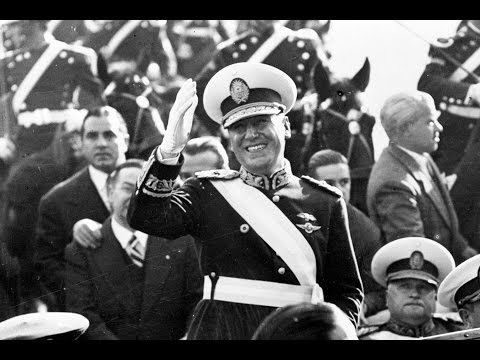
Subject of what many consider the most powerful political mythology in the modern history of Argentina—that of Peronismo (Peronism)—Juan Domingo Perón remains, despite his eminently public life, a deeply enigmatic figure—at once a populist, a man of the people, a friend of the working class, a dictator, a demagogue, an enemy and ally of the military, and the politician most responsible for a host of failed government policies that nonetheless continue to resonate among large segments of the populace.

For three decades—from his burst onto the political stage in 1944–45 until his death in office in 1974—Perón dominated the Argentine political landscape, while his ambiguous and divisive legacy endured long after his death. Understanding modern Argentine history requires understanding the complex political legacy he bequeathed.

Born on October 8, 1895, in a small town near Lobos in the province of Buenos Aires to a farming family, by some accounts out of wedlock, Perón entered the military at age 16 and rose gradually in rank.


In 1929 he married Aurelia Tizón, who died nine years later of uterine cancer. In 1938, the year of his wife’s death, he traveled widely in Europe, where he came to admire the regime of Italian fascist dictator Benito Mussolini.

In 1943 he participated in a coup against the conservative regime of Ramón Castillo, and soon after became head of the Department of Labor—one of the weakest government ministries—which he used as a platform to build his own power base, forging alliances with segments of Buenos Aires’s powerful labor unions.

Named vice president and secretary of war, on October 9, 1945, he was ousted and jailed by enemies in the military. There followed one of the defining events of modern Argentine history, when mass demonstrations by los descamisados (the shirtless ones) forced his release on October 17.

Four days later he married the actress Eva (Evita) Duarte. Until her death, also from uterine cancer, in July 1952 at age 33, Evita was wildly popular among working people and coequal in creating and popularizing the Perón mythology.

Building on his strong political momentum, Perón was elected president in February 1946. During his first term (1946–52), at the height of his political power, he implemented a host of populist policies intended to solidify his support among the country’s powerful labor unions, proclaiming his populist vision a "third position" between capitalism and communism.

His policies sparked rising government debt and growing economic crisis while polarizing Argentine society into Peronist and anti-Peronist factions. Reelected in 1951, he was ousted in September 1955 in a military coup. For the next 18 years he lived in exile, mainly in Spain, in 1961 marrying nightclub singer María Estela Martínez, or Isabel Perón.

Following years of military dictatorship marked by growing social discord and political polarization, he returned to Argentina in 1973 and won his third term as president. He died in office on July 1, 1974, his wife and vice president, Isabel, succeeding him until her ouster by a military coup in March 1976.