Showing posts with label USA. Show all posts

American Indian Movement (AIM)

American Indian Movement (AIM)

Relations between Native peoples and U.S. federal and state governments soon after World War II swung between paternalism and indifference. Native Americans responded with a new militancy that echoed the Civil Rights movement and, by 1968, produced the American Indian Movement (AIM).

“Red power,” expressed in lawsuits, sit-ins, and demonstrations—some of them violent—created greater awareness of Native rights and fostered new economic and educational initiatives. But many Indians remained desperately poor and isolated.

In the 1950s federal policies reverted to a pre–New Deal relationship with Native tribes. Indians were once again urged to assimilate, giving up tribal political rights and long-standing land claims. Natives were encouraged to relocate from reservations to urban areas. More than 100 tribes were stripped of their sovereignty and benefits. The federal Bureau of Indian Affairs (BIA), never beloved but still useful to Native groups, lost much of its mission.


This again changed dramatically in 1962 when President John F. Kennedy ushered in what became known as the Self-Determination Era. Kennedy was first in a series of presidents of both parties to take Indian cultural and economic claims more seriously. Natives benefited from Great Society programs. President Richard Nixon played a major role as a proponent of the 1974 Indian Self-Determination and Education Assistance Act.

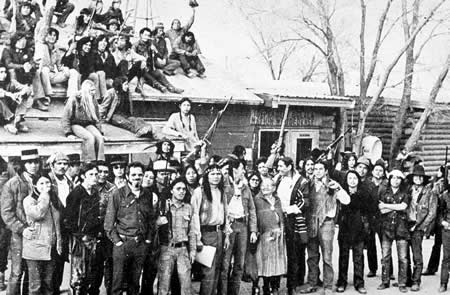
By then the American Indian Movement was well under way. In 1969 AIM members occupied Alcatraz, the San Francisco Bay island formerly used as a federal prison. They would remain there, reclaiming Alcatraz as Indian land, for almost two years. In 1971 protesters briefly occupied Mount Rushmore, the South Dakota presidential monument near the 1876 site of a Sioux rout of General George Custer.

Not all AIM protests were peaceful. In 1973 a violent clash at Wounded Knee, South Dakota, killed two activists and badly wounded a federal agent. It ended after 73 days when the Nixon administration promised to review an 1868 treaty. AIM activist Leonard Peltier, who grew up on North Dakota’s Anishinabe Turtle Mountain Reservation, received two life sentences for murdering two federal agents during a 1975 shoot-out on the Pine Ridge Indian Reservation. Human rights groups maintain his innocence.

American Indian Movement (AIM)

The overall trajectory of U.S.-Native relations was toward greater autonomy and respect. Some “terminated” tribes, like the Menominee of the northern Great Lakes, had their authority restored. A 1971 Alaskan Native Claims Settlement Act and a 2000 restoration of 84,000 acres to Utah’s Ute tribe (accompanied by an official apology) advanced self-determination.

During the presidency of George H. W. Bush, almost 90 percent of BIA staff had tribal roots. U.S. courts, dusting off long-ignored treaties, restored many Native rights related to fishing, farming, travel, and sovereignty.

In 1979 Florida’s Seminole were the first to use court-affirmed rights to run bingo games. By the mid1990s more than 100 casinos were operating on reservation lands across the United States. Gaming and other new businesses, including tax-free sales of tobacco and other highly taxed products, enriched many tribes. Some assimilated Natives reaffiliated with their tribes to participate in this new economy.

But reliance on the greed of non-Indians proved no solution for fundamental inequities. Approximately 28,000 residents of Pine Ridge, the 3,500-square-mile Oglala Sioux reservation, live with high unemployment and annual family incomes below $4,000. High suicide and infant mortality rates have made life expectancy at Pine Ridge the nation’s shortest.

Arab-Israeli War (1956)

Arab-Israeli War (1956)

The nationalization of the Suez Canal was the ostensible cause for the 1956 Arab-Israeli War. After the United States refused aid for building the Aswan Dam on July 26, the anniversary of the 1952 revolution, Gamal Abdel Nasser nationalized the Suez Canal to finance building of the dam, Nasser’s dream project.

Egypt managed to keep the canal running, much to the consternation of France and Britain. In announcing the canal’s nationalization, Nasser had carefully adhered to international law. The United States, especially the secretary of state, John Foster Dulles, an expert in international law, opposed the use of force to retake the canal and instead proposed a diplomatic settlement.

The oil shipped through the canal was vital to the British and French economies, and it was apparent that the United States, then self-sufficient in oil, did not intend to supplement any possible oil losses to its European allies. Great Britain and France were determined to take back the canal by force.


The British prime minister, Anthony Eden, personally detested Nasser, and his conservative Tory government was reluctant to cede British imperial control. The French were angry over Nasser’s support for the Algerians in the ongoing war there. Israelis feared Nasser’s growing popularity in the Arab world and wanted him removed from power before he could unify the Arabs and possibly form a united front to attack them.

The Israelis secretly approached the French with a proposal for a joint military action against Egypt; the French then brought Great Britain into the plan. Although some British cabinet members opposed joining the alliance, Eden was determined to bring Nasser’s regime down, and the tripartite agreement of the French, British, and Israelis was concluded.

According to the plan Israel was to launch a tripronged attack across the Sinai Peninsula, quickly take the territory, and stop the offensive prior to reaching the canal. The British and French would bombard Egyptian airfields and parachute forces along the canal on the supposed excuse that they were there to stop the war between Egypt and Israel.

Operation Musketeer 1956

The Israelis launched the attack in October 1956, quickly cut through Egyptian defense lines, took the Sinai, but then stopped before reaching the banks of the canal. The British and French were late in launching their attack but ultimately took control of the canal.

The war was a clear-cut military victory for Israel, Britain, and France, but Nasser immediately accused the three nations of collusion. Although Eden and the French for years publicly denied any collusion, ultimately firsthand accounts by Israeli and other military and political leaders revealed the secret agreement.

With some justification, Nasser argued that the attack proved that Britain and France still had imperialist designs on the Arab world and that Israel was also a threat to its Arab neighbors. Nasser thus turned a military defeat into a political victory and became the most popular man in the Arab world. Contrary to Western and Israeli hopes, Nasser was not overthrown, and he consolidated power after the 1956 war.

The war placed the United States in the awkward position of having to condemn its closest allies in the United Nations. The Soviets gained popularity in the Arab world by supporting Egypt. The war also diverted world attention away from the brutal suppression of the 1956 Hungarian revolt by Soviet forces.

In the face of international condemnation, Britain and France were forced to withdraw in December 1956, and the canal reverted to Egyptian control. Subsequently Eden, suffering from ill health in part brought on by the stress of the conflict, stepped down as prime minister. The Israelis were reluctant to withdraw from the strategic area of Sharm al-Sheikh in the south of Sinai and the Gaza Strip.

President Eisenhower intervened and threatened to cut off all United States economic aid if they did not return all the territories to Egypt. Israeli forces finally left in March 1957. However, Israel did gain a unilateral agreement from the United States that the Gulf of Aqaba up to the southern Israeli port of Elath was to be considered an international waterway.

Egypt and the Arab states never recognized the legality of Aqaba as an international waterway but for a decade did not challenge Israeli shipping through the gulf. Israel made it clear that any future closure of the waterway would be casus belli, or cause for war, and its threatened closure was one cause of the 1967 Arab-Israeli War.

ANZUS Treaty

ANZUS Treaty
ANZUS Treaty

The ANZUS Security Treaty binds together Australia, New Zealand, and the United States. ANZUS was signed in San Francisco on September 1, 1951, and took effect on April 28, 1952. It remains in force, although it has increasingly come under attack by both Australia and New Zealand since the 1980s and New Zealand has essentially withdrawn from the alliance.

Beginning in the late 1940s the United States abandoned the isolationist impulse that had directed its foreign policy in previous decades to form and maintain a global network of alliances. United States policy makers in the cold war were especially interested in opposing the rise of communism. Following the outbreak of the Korean War in 1950, the United States became concerned with constructing a series of regional security arrangements to guard against communist attacks.

For Australia and New Zealand, alliances were a necessity because of their need for protection, particularly from Communist China, the Soviet Union, and due to the problems associated with decolonization in Asia and the Pacific. Both countries were also concerned about the return of Japan to sovereign status, and sought a replacement for Great Britain as a dependable security guarantor. The United States offered exactly what both sought.


The ANZUS Treaty stipulates that an armed attack on New Zealand, Australia, or the United States would be dangerous to each signatory’s own peace and safety. Accordingly, each country would act to meet the common danger in step with its constitutional processes. In the early and mid-1950s the United States rejected Australian efforts to move toward more security cooperation such as cooperative and systematic military planning and the designation of national security units that might fall under the ANZUS name and assignment, similar to the North Atlantic Treaty Organization (NATO) model.

After the ANZUS pact was signed, nonsecurity ties between the three countries grew, paralleling the building of their security relations. Commercial, cultural, and other forms of U.S. influence were largely welcomed during the cold war years. The great disparity of size and power generated irritation within Australia and New Zealand, however, and both countries complained about the way they were treated by the United States, although both developed close military cooperation with the United States. Australia, in particular, became a valuable site for U.S. communication and surveillance facilities and naval ship visits.

As the cold war began to wind down in the 1980s, the threat from outside sources lessened. Citizens of the two nations, particularly among members of the labor, began to question the elaborate security ties with the United States. Citizens of New Zealand and Australia challenged ANZUS as more a method for the United States to enlist support for its military agenda than a means of providing security for them.

In 1984 New Zealand banned the entry of U.S. Navy ships into its ports in the belief that the ships were carrying nuclear weapons or were nuclear powered. The United States argued that New Zealand’s action compromised U.S. military operations. Additionally, Americans were offended by the manner in which New Zealand presented its differences with U.S. policy makers.

When President Ronald Reagan announced in 1986 that the United States would decline to abide by the provisions of the unratified Strategic Arms Limitation Treaty (SALT) II that restricted nuclear weapons, New Zealand stated that the United States had not been negotiating in good faith. The United States responded by rescinding its ANZUS-based security obligations toward New Zealand in 1986.

The future of ANZUS is in doubt. New Zealand has shown no indication that it wants to resume the partnership. For Australia, the alliance with the United States has continued to be a foundation of its defense policy.

Arab-Israeli-Palestinian Peace Negotiations

Arab-Israeli-Palestinian Peace Negotiations

Five major wars and numerous peace negotiations have failed to resolve the ongoing conflict between the Israelis and Palestinians over land and statehood. Israel declared its independence and won the first war against opposing Arab states and the Palestinians in 1948.

The 1949 armistice mediated by Ralph Bunche, a United States diplomat to the United Nations, ended the hostilities but did not result in an actual peace treaty, and technically a state of war still existed. Although the Arab states refused to recognize Israel, Gamal Abdel Nasser of Egypt supported behind-the-scenes secret negotiations in the early 1950s, but when Israeli Prime Minister David Ben-Gurion demanded face-to-face negotiations, the diplomatic efforts failed.

After the 1956 war, the United Nations, with Egypt’s agreement, placed peacekeeping forces in the Sinai Peninsula (Egyptian territory) at strategic locations along the borders between Israel and Egypt. Their removal at Egypt’s request was the ostensible cause of the 1967 war in which Israel decisively defeated the surrounding Arab nations and occupied East Jerusalem, the West Bank, the Gaza Strip, the Golan Heights (Syrian territory), and the Sinai Peninsula (Egyptian territory).


Following this major victory, Israel expected the Arabs to sue for peace and that some border modifications would be made. However, the Arabs refused to negotiate until Israel had withdrawn from all the territory occupied in the 1967 war and that some resolution of the Palestinian refugee issue and demands for self-determination had been achieved.

Following the 1967 war, the Palestinians concluded that only armed struggle against Israel would achieve their national aspirations, and the Palestine Liberation Organization (PLO) emerged as their sole political and military representative. Israel and its United States ally both considered the PLO a terrorist organization and refused to negotiate with it. Various diplomatic settlements were suggested but all failed to break the impasse.

Shuttle Diplomacy

To regain the Sinai and to bring the United States in as a mediator to the dispute, Anwar Sadat of Egypt launched a surprise attack against the Israeli forces occupying Sinai in 1973. Although Israel suffered some initial defeats, its military soon recovered and regained the offensive.

With United States and UN diplomacy, a cease-fire was declared, and both sides announced they had won the war. The United States secretary of state, Henry Kissinger, then embarked on shuttle diplomacy between Israel, Egypt, Jordan, Syria, and Israel in an attempt to reach a settlement to the conflict.

He envisioned a step-by-step process that the U.S. would control. As a result, various phased withdrawals of Israeli forces from the Sinai were agreed upon and were to be guaranteed by U.S. forces stationed in the peninsula, but the overall cause of the conflict, namely the conflicting claims of Israel and the Palestinians, remained unresolved.

Sadat attempted to revive the process by making a dramatic visit to Israel, where he spoke before the Knesset, the Israeli parliament, in 1977. Sadat was the first Arab leader publicly to visit Israel, and his gesture altered the psychological dimensions of the conflict and made it appear that peace between the Arabs and Israel was possible.

In 1978 the United States president Jimmy Carter brought Israeli prime minister Menachem Begin and Sadat together for 13 days of occasionally acrimonious negotiations at Camp David. These negotiations led to the 1979 peace treaty between Egypt and Israel that was signed at a well-publicized ceremony hosted by Carter on the White House lawn in 1979. The treaty provided for the gradual withdrawal of Israeli forces from the Sinai and full diplomatic recognition between the two states.

Carter anticipated that further negotiations to resolve the differences between Israel and the Palestinians, the cessation of Israeli settlements in the Occupied Territories, and the return of some land for an overall peace settlement would follow. The Arab states and the Palestinians rejected the treaty because it did not resolve most of the basic issues, and Israel continued to build settlements in the territories, further angering the Palestinians.

In 1981 Egyptian Islamists who opposed the treaty assassinated Sadat; however, his successor, Hosni Mubarak, maintained the treaty in what has been called a “cold peace” between Egypt and Israel. In 1984 a full peace treaty between Israel and Jordan under King Hussein was signed. Hussein and then Israeli prime minister Yitzhak Rabin, both military officers, had a cordial relationship, and this treaty has also held.

During the 1970s the PLO also gained recognition from a number of nations around the world. In spite of Israel’s opposition, Yasir Arafat even addressed the UN General Assembly in New York City. Israel attempted to eliminate the PLO by attacking its power base in Lebanon in 1982.

The war seriously damaged the PLO infrastructure but did not destroy the organization that, with international assent, moved its base of operations to Tunisia. UN peace-keeping forces remained in southern Lebanon along the Israeli border, but a new indigenous Lebanese Islamist movement, Hizbollah, then began attacks on Israeli forces both in Lebanon and Israel.

As early as 1974 the PLO hinted at the acceptance of a two state solution, or the so-called Palestinian ministate comprising East Jerusalem, the West Bank, and the Gaza Strip, occupied by Israel in the 1967 war. The Arab governments also made gestures regarding acceptance of Israel; the Fahd Plan of 1982, sponsored by Saudi Arabia, called for all the states in the region to live in peace.

The Fez Plan of 1982 reiterated the Arab states’ willingness to consider trading land for peace as long as some form of Palestinian self-determination was achieved. These overtures were largely ignored by both Israel and its major ally, the United States, although the United States did have some secret contacts with the PLO.

After 1988, when the PLO and Arafat agreed to recognize Israel’s right to exist, to recognize UN Resolution 242, and to renounce terrorism, the United States agreed publicly to negotiate with it as the representative of the Palestinians.

The PLO and Arafat were further weakened by their support for Saddam Hussein during the First Gulf War; in retaliation the Gulf States, especially Kuwait, halted financial support for the PLO, and Kuwait ousted tens of thousands of Palestinians who then generally took refugee in Jordan. With the collapse of the Soviet Union the PLO also lost a key ally.

With the end of the cold war, the United States became the major mediator in the long-running dispute. In 1991 U.S. Secretary of State James Baker succeeded in bringing all of the parties to the conflict—Jordanians, Syrians, Israelis, and Palestinians—together for the first time for direct negotiations.

The Palestinians were represented by a delegation from the Occupied Territories who unofficially represented the PLO. The Israeli prime minister, Yitzhak Shamir of Likud, the hard-line Right party, was a reluctant participant, and the negotiations dragged on without appreciable progress until 1993.

Direct Negotiations

At the same time, in 1993 the new Israeli Labor Party government under Yitzhak Rabin and Shimon Peres agreed to direct negotiations with PLO representatives. These top secret talks were held in Norway, a respected neutral party, and resulted in the first Oslo Accords.

The accords included the Declaration of Principles (DOP) and letters of mutual recognition that were publicly signed in September 1993 on the White House lawn with President Bill Clinton as host. The occasion culminated with a famous handshake between the two old enemies, Israeli prime minister Yitzhak Rabin and Yasir Arafat.

Under Oslo I, Israel agreed to withdraw from Jericho and most of the Gaza Strip, and a five-year process of negotiations for further withdrawals was to result in the creation of what the Palestinians believed would be an independent Palestinian state. The PLO was to maintain order in its territories and prevent attacks on Israelis.

The territories were then turned over to the Palestine Authority under the PLO. In 1994 a Jewish settler massacred Palestinian worshippers in the Ibrahimi Mosque in Hebron; and Hamas, the main Palestinian Islamist group, retaliated with a car bomb in Israel that killed Israeli civilians. Arafat condemned suicide attacks, but they continued. Meanwhile, the PA was also charged with corruption and inefficiency and lost much popular support among the Palestinians.

Under Oslo II in 1995, Israel began a phased withdrawal from Ramallah, Nablus, and Bethlehem on the West Bank. However, the issues of Israeli settlements, the final status of Jerusalem, and the refugees remained undecided. Militants on both sides opposed these agreements, and in 1995 an Israeli radical assassinated Rabin. Meanwhile, violence in the territories continued. None of these negotiations settled the dispute between Israel and Syria regarding the Golan Heights.

The Likud, under Binyamin Netanyahu, won the elections following Rabin’s death, and once again the negotiations stalled. Israel withdrew from Hebron in 1997, one year past the agreed upon time frame. In the Wye Memorandum of 1998 (named after the Wye Plantation in Maryland where the talks were held) the United States mediated further Israeli withdrawals, and Arafat pledged to combat terrorism and to take steps to ensure further Israeli security.

However, Netanyahu’s government collapsed owing to mounting opposition from within his own party, and the withdrawals were delayed. Thus the expected deadline of 1999 passed without the establishment of a viable independent Palestinian state on the 22 percent of historic Palestine proposed for it. In addition, new Jewish settlements continued to be built or enlarged within the territories still held by Israel.

In a popular move within Israel, Prime Minister Ehud Barak withdrew Israeli troops from southern Lebanon in spring 2000. In the summer Barak met with President Clinton and Arafat at Camp David. At Camp David Barak presented an offer for a final settlement that involved the Israeli withdrawal from much of the West Bank and the Gaza Strip; Israeli control over the airspace, water aquifers and all of Jerusalem; the denial of the right of return of Palestinian refugees; and the continuation of some of the settlements.

Although Clinton pressured Arafat to accept the proposal, Arafat knew he could not agree to give up the right of return and some Palestinian control over East Jerusalem, particularly the holy site of Haram al-Sharif, and survive politically. He rejected the offer but failed or refused to present a counter offer, and the talks failed.

Shortly thereafter a Palestinian uprising, the al-Aqsa Intifada, broke out. As the violence mounted, many Israelis lost confidence in the peace process and Barak. A last attempt to revive the process was made at Taba (in the Sinai Peninsula close to the Israeli border) in January 2001. Under the Taba proposals, Israeli would retain about 6 percent of the West Bank, reduce the number of settlements, and the Palestinians would receive a state.

But the two sides could not agree on the status of Jerusalem, the right of return, or the Israeli settlement near Jericho that effectively split the Palestinian West Bank into two parts. The Likud Party under Ariel Sharon won the ensuing Israeli elections, and Sharon became the new prime minister in 2001; he supported the crushing of the al-Aqsa uprising by military means.

The Arab states adopted the Saudi peace initiative whereby they would recognize Israeli in exchange for the creation of a Palestinian state in the territories in 2002. In 2003 some former Israeli officials and leading PLO members proposed the Geneva Plan. Rather than adopting the step-by-step process that had not succeeded, this plan was a full comprehensive agreement, in which the end game was known.

The plan provided for a Palestinian state in most of the West Bank and all of the Gaza Strip and Israeli control over three settlement blocs in the West Bank and around Jerusalem. Palestinians would control the Haram al-Sharif in East Jerusalem, and Jews would control the Wailing Wall.

The refugees would receive some compensation and the freedom to return to the Palestinian state. Provisions were made for mediation of disputes, and the Palestinians were to have a security force, not an army. Israel would keep two monitoring posts as an early warning system on the West Bank for no more than 15 years.

Sharon rejected the plan although it received some muted political support within Israel. Arafat did not give full assent for the plan but did not openly reject it. Nor did other states, especially the United States, adopt the plan, and it died for want of support.

Sharon and his successor, Ehud Olmert, adopted a policy of unilateral disengagement whereby Israel made decisions without negotiations or discussions with the Palestinians. Israel withdrew from the Gaza Strip and dismantled the settlements, but periodically launched military attacks into the territory and retained control over its borders, thereby cutting it off from trade and outside support.

The Bush administration’s support for Israel and Sharon lessened the credibility of the U.S. as a neutral mediator to the dispute among Palestinians and other Arabs. After Hamas won the Palestinian elections in 2006 negotiations broke down entirely.

Although Hamas suggested implementing a long-term cease-fire, it refused to recognize Israel’s right to exist. Israel considered Hamas, which continued suicide bomb attacks against Israelis within the territories and Israel proper, a terrorist organization and rejected all negotiations with it.

As the peace process dragged on, a generation of disillusioned and angry Palestinians grew up under Israeli military occupation. Conversely, many Israelis knew the Palestinians only as suicide bombers or violent opponents.

Arab-Israeli War (1967)

Arab-Israeli War (1967)

The 1967 Arab-Israeli War lasted six days and was a resounding military victory for Israel but failed to achieve a resolution to the Arab-Israeli conflict. In 1966 border incidents and incursions into Israel by Fatah Palestinian guerrilla fighters increased, and Israeli launched a major military raid into Jordan in the fall of 1966.

In spring 1967 the Israeli prime minister, Levi Eshkol—a dove by Israeli political standards—responded to demands for a stronger stance against Arab provocations by agreeing to the cultivation of demilitarized zones along the border with Syria.

Predictably Syria opened fire, and Israel retaliated by shooting down a number of Syrian jet fighters. The Syrians, presumably encouraged by their Soviet allies, believed they were about to be attacked by Israel and appealed to their ally Gamal Abdel Nasser in Egypt for help.


In an attempt to gain diplomatic support and to look like he was doing something for his Arab allies, on May 16 Nasser asked that the UN withdraw its peacekeeping troops from the frontier posts in the Sinai Peninsula. Nasser mistakenly believed that a protracted period of negotiations would follow; however, according to the UN Charter troops could only be placed in a territory at the invitation of the host country.

Consequently, the UN secretary-general U Thant promptly acceded to the Egyptian request and ordered the withdrawal of the peacekeeping force. Egyptian units occupied the posts including the vital Sharm al-Sheikh position along the Gulf of Aqaba, on May 21. Nasser then gave conflicting statements as to whether the waterway would be closed to shipping going to the southern Israeli port of Elath.

After the 1956 Arab-Israeli War, Israel had announced that it would view any closure of the waterway as casus belli, or cause for war. On May 23 United States president Lyndon B. Johnson publicly announced that the United States considered the waterway an international one, thereby supporting the Israeli position.

Israeli tank army
Israeli tank army

Eshkol advised caution in an attempt to avoid full-scale war, but military leaders and hawks in Israel favored immediate action. A flurry of diplomatic activity ensued, with Nasser seeing UN and United States representatives in Cairo and Abba Eban of Israel touring the Great Powers to secure their support in the event of war. The Soviets feared a full-scale war that might escalate into a confrontation between the superpowers and used the hotline to Washington to prevent either power from becoming directly involved.

After receiving notes from both Johnson and the Soviets urging calm, Eskhol convinced most of the Israeli cabinet ministers on May 28 that all diplomatic measures should be used before recourse to war. However, irresponsible rhetoric by Arab leaders inflamed fears among Israelis that they were about to be overrun by Arab forces and also convinced Arabs that their militaries would win any war with Israel.

Although the CIA and other experts predicted that Israel, with its military superiority, would quickly win any war with its Arab neighbors, the general public in the West, especially in the United States, was also convinced that Israel was in peril.

On May 30 Egypt and Jordan joined in a joint defense pact, and the PLO was allowed to open offices in Jordan. Iraq also joined the pact. Nasser was approached by both the Soviets and the United States urging a diplomatic settlement and apparently believed that Israel would not attack as long as diplomatic negotiations were in process.

On May 31 General Moshe Dayan, a noted hawk, became the Israeli defense minister, and war seemed likely. On June 5 the Israeli air force launched surprise attacks against Egypt, Jordan, Iraq, and Syria. Within two hours over 400 Arab planes had been destroyed, almost all on the ground. In spite of the boasts by Arab leaders, their militaries had not been prepared for war.

With total air superiority Israel launched a threepronged attack (almost a repeat of the military action in the 1956 war) and easily cut through the Egyptian forces, taking the Gaza Strip (administered by Egypt) and also moved across Sinai to the east bank of the Suez Canal. On June 8 Israel and Egypt agreed to a ceasefire in the Sinai.

On June 5 Israeli forces also moved against Jordanian forces in the West Bank, taking all of the West Bank and East Jerusalem by June 7. Over 100,000 more Palestinians became refugees as thousands fled across the Jordan River to escape the war. On June 27 the Knesset agreed to a proclamation that Jerusalem was one city.

On June 8 Israeli forces moved against Syria in the north while the UN was still negotiating a cease-fire. In a still unexplained attack, Israel, on the same day, torpedoed the USS Liberty, a spy ship deployed in the eastern Mediterranean. By June 9 Israel had taken the Golan Heights from Syria, and a cease-fire was agreed to on June 10.

Taking responsibility for the disastrous defeat, Nasser resigned on June 9 but was brought back to power by popular acclaim. In support of their Arab allies the Soviet bloc severed diplomatic relations with Israel in the following days. In the war, the Arabs suffered over 26,000 killed, wounded, captured, or missing and lost over 1,200 tanks. Israel lost 6,000 killed, wounded, captured, or missing; 100 tanks; and 40 airplanes.

UN Resolution 242 called for the return of territories taken in war but pointedly did not specify all of the territories; this would become a point of contention in future negotiations. The war had been a humiliating loss for the Arab states. Owing to its decisive victory, Israel expected a full settlement, but no Arab government could hope to survive if it accepted an agreement with Israel that did not provide for the return of the newly conquered territory and the recognition of some form of Palestinian state. The impacts of the war were far-reaching and continue to reverberate in the region to the present day.

After the war, Israel announced that it would only accept face-to-face negotiations with the Arabs. From June 14 to 16, Arab leaders met at Khartoum, Sudan, and forged a united front. They announced that there would be no negotiations with Israel until it withdrew from the Occupied Territories and that no separate peace would be made by any individual Arab state. This caused Egypt’s ostracism from the Arab world following Sadat’s unilateral peace treaty with Israel in 1979. As a consequence of the impasse, Israel continued to occupy all of the Sinai Peninsula (Egyptian territory), the Gaza Strip, the West Bank, East Jerusalem, and the Golan Heights (Syrian territory).

The Soviets rearmed Egypt and Syria and increased their presence in the region. From 1968 to 1970 Nasser waged a war of attrition along the canal, and the Israelis built what they believed to be an impregnable defense line on the east bank of the canal. The line was breached by an Egyptian offensive in the 1973 Arab-Israeli War.

Initially Israel was probably willing to return most of the Occupied Territories in exchange for a full peace and recognition by the Arab states. The longer Israel held the territories and the more Israeli settlements were established, the less land it was willing to trade for peace.

As a result of the war Palestinians concluded that the Arab governments would not be able to achieve their goal of an independent Palestinian state and that they would have to rely on themselves. This directly contributed to the growth of the Palestine Liberation Organization (PLO) as the sole representative of the Palestinian people. It also set the stage for a cycle of violence between Palestinian and Israeli forces that continued into the 21st century.

Arab-Israeli War (1973)

Egyptian army crossing suez canal

The 1973 Arab-Israeli War (October 6–26), known as the Yom Kippur War in Israel and the Ramadan War among Arabs, was the fourth major military conflict between Israel and its Arab neighbors. During the 1967 Arab-Israeli War, Israel occupied Egyptian, Syrian, and Jordanian-Palestinian territories; despite international efforts by United States secretary of state William Rogers and UN special envoy Gunnar Jarring, no peace agreement was reached, and Israel continued to occupy the territories taken in 1967. Although in March 1972 Syrian president Hafez al-Assad publicly expressed his readiness to accept UN Resolution 242 recognizing Israel with the return of all of the Syrian Golan Heights, Israeli policy remained unchanged.

Syria and Egypt, with the support of Saudi Arabia, therefore decided to initiate a limited war in order to break the political stalemate. The Egyptian president, Anwar el-Sadat, was also anxious to relieve domestic discontent and to force the Soviet Union to supply Egypt with more advanced weaponry.

It appears that Sadat and al-Assad began the secret planning of a joint strategy in 1971 and by the end of the year had reached an agreement on a broad strategy of action. In August 1973 the Egyptian chief of staff, Lieutenant General Saad el-Shazly, and his Syrian counterpart, Yusuf Shakkur, formally agreed on two possible dates for the war: September 7–11 or October 5–10. Less than a week later Egypt and Syria agreed on October 6.


At the time, in spite of Arab military preparations, Israeli military intelligence did not believe that war was imminent. The possibility of Israel’s being taken by surprise was not seriously considered, nor was the thought accepted as valid that Arabs might launch a limited war to force serious political negotiations.

The Egyptian and Syrian attack on October 6 was therefore an unpleasant and shocking surprise for Israel. Hostilities began when the Syrians attacked the Golan Heights and the Egyptian army surprised Israel by crossing the Suez Canal on a pontoon bridge and by breaching the supposedly impregnable Israeli Bar Lev Defense Line in Sinai. Syrian armored and infantry divisions stormed the Golan plateau but were stopped several miles from the eastern shore of Lake Tiberias and the River Jordan.

On October 8 the Israeli defense minister, Moshe Dayan, ordered the deployment of Israeli nuclear weapons, fearing that the “third temple” (the state of Israel) might be in danger. His fears proved premature; the Israeli army regained the initiative, and General Ariel Sharon launched a counteroffensive and established a bridgehead on the east bank of the Suez Canal, only 60 miles from Cairo. A cease-fire was agreed upon on October 24. The situation was similar in the north, where Syrian advances on the Golan were reversed, and the outskirts of Damascus came into range of Israeli artillery.

Three major factors enabled the Israeli forces to reverse their initial losses. First, once the superior Israeli military forces had been fully mobilized they retook initiatives on both fronts. Second, a crucial role was played by an enormous airlift of U.S. military supplies. The airlift, larger than the Berlin airlift, provided Israel with some 24,000 tons of arms, ammunition, tanks, missiles, and howitzers.

Destroyed israeli tank

A third and crucial factor was the differing political and strategic goals of Sadat and al-Assad. Sadat had started a limited war to shatter the status quo and pressure the United States to mediate the dispute in order to regain the Sinai Peninsula. Assad wanted to retake the entire Golan and put pressure on Israel to give up the occupied Palestinian territories.

After two days of successful advances, the Egyptian forces were ordered to adopt a defensive stance by Sadat, but, in reaction to Syrian setbacks in the north and the U.S. airlift, Egyptian forces reinitiated the attack against Israel on October 14. However, they failed to regain the initiative.

The Soviet Union was reluctant to become further involved, and U.S. secretary of state Henry Kissinger’s skillful diplomacy resulted in a political gain for the United States and the drawing closer together of the United States and Sadat.

On October 22 the UN Security Council passed Resolution 338 calling on “all parties to the present fighting to cease all firing and terminate all military activity ... to start immediately after the cease-fire the implementation of the Security Council Resolution 242 in all of its parts aimed at establishing just and durable peace in the Middle East.” Sadat accepted the cease-fire, and Syria officially recognized it on October 23.

Israel continued its military action against Egypt, however, and on the evening of October 23 Soviet leader Leonid Brezhnev sent a letter to U.S. president Richard Nixon proposing joint U.S.-Soviet intervention to ensure the cease-fire. He also threatened that if the United States did not take action, the Soviet Union would be faced with the urgent necessity to “consider taking appropriate steps unilaterally.” In response Kissinger put U.S. forces on full nuclear alert on October 24.

The Soviets did not intervene and over the next few days the cease-fire was implemented. Although Israel proved victorious in the end, the war had been a great shock to the state. For the Arabs, the war was a limited success and seemed to rehabilitate the Egyptian army after its disastrous defeat in the 1967 war.

In May 1974 Syria and Israel reached a disengagement agreement, and Israel agreed to withdraw from parts of the Golan and the town of Quneitra but continued to occupy the rest of the Golan. Assad’s achievements improved his image in Syria. The war also increased U.S. power and weakened Soviet influence in the region. The United States subsequently mediated negotiations between Egypt and Israel, leading toward the Camp David accords and the Egyptian-Israeli peace treaty in 1979.

Bay of Pigs

Bay of Pigs invasion

In April 1961 putting into effect a plan initially formulated by the Central Intelligence Agency (CIA) under the Dwight D. Eisenhower administration, U.S. President John F. Kennedy authorized the Bay of Pigs invasion to topple Cuban revolutionary Fidel Castro.

The plan was for a U.S.-trained and equipped force of Cuban exiles to invade Playa Girón in the Bahía de Cochinos (Bay of Pigs) on the south coast and spark a popular uprising against Fidel Castro, which would overthrow his regime and end Cuba’s Communist experiment.

Ill-conceived from its inception, and plagued by mishaps and missteps, the invasion failed, becoming a major foreign policy embarrassment for John F. Kennedy and solidifying popular support for Castro within Cuba. A few months later, Cuban revolutionary leader Che Guevara thanked a Kennedy aide for the invasion, which Guevara claimed “enabled [us] to consolidate” the revolution and “transformed [us] from an aggrieved little country to an equal.”


The Bay of Pigs fiasco also had major repercussions for the cold war, helping to precipitate the Cuban missile crisis, convincing the Kremlin that John F. Kennedy was weak and indecisive, and steeling Kennedy’s resolve to stand up to the perceived menace of global communism.

Operational planning for the invasion began in March 1960, headed by Vice President Richard Nixon. This was in the wake of the successful CIA sponsored incursions into Iran (1953) and Guatemala (1954), which resulted in the installation of governments friendly to the United States.

The CIA secretly recruited a Cuban exile force of some 1,000 men, called Brigade 2506, which underwent training in south Florida and Guatemala. The original landing site near Trinidad, Cuba, was later changed to the Bay of Pigs. Operations began on April 15 with a failed effort to destroy the Cuban Revolutionary Air Force.

captured united states soldier

Two days later, four privately chartered ships transported 1,511 Cuban exiles to the Bay of Pigs, accompanied by CIA-owned landing crafts carrying supplies. Fighting was fierce and lasted for four days (April 17–21). Casualties are estimated at 2,000 to 5,000 Cubans and 200–300 invading exiles. John F. Kennedy refused to send in air support or the marines, fearing the consequences of clear evidence of direct United States involvement.

The Cuban Revolutionary Armed Forces soon killed or captured most of the invading force. Soon afterward, 1,209 captive exiles were put on trial. Around 20 were executed or otherwise killed, the remainder being released within two years in exchange for $53 million in medicine and food.

victorius cuban army

The botched invasion was a major blow to the Kennedy administration and gave a major boost to Castro at home and abroad. Kennedy’s vacillating leadership during the Bay of Pigs prompted Soviet Premier Nikita Khrushchev to challenge the U.S. administration more directly by placing nuclear-armed missiles in Cuba, leading to the Cuban missile crisis of October 1962.

Until his assassination in November 1963, John F. Kennedy endeavored to demonstrate his strength in confronting the Soviet Union and its allies in Europe, Asia, and Latin America, a foreign policy stance attributable in large part to the Bay of Pigs debacle.

Beat Movement

Beat Movement
Beat Movement

Every generation has its own avant-garde movement, and the Beats were the avant-garde of the 1950s in the United States, providing an acerbic critique of what they believed was a bland, conformist, and frivolous society. The writers associated with the movement had a disproportionate influence for their numbers.

They worked outside traditional creative forms and behavior, placing immense value on personal freedom and spontaneity and viewing themselves as poets in a philistine nation. They used their immediate raw experience—sometimes drug fueled—as the basis for their writing, and used patterns of plain American speech but also adopted the rhythms of progressive jazz and bebop.

The movement began in 1945, when Jack Kerouac and Allen Ginsberg, students at Columbia University, met William S. Burroughs in New York City. The movement got its name from an article that John Clellon Brown, a novelist of the movement, wrote for the New York Times in 1952. In the article Brown talked of a “new vision” invented from the everyday surroundings of the writers that sustained their “perfect craving to believe” in the United States promise of freedom in the tense cold war years.


The movement made headlines in 1956 when Lawrence Ferlinghetti, a poet and the proprietor of San Francisco’s City Lights Bookstore, published Ginsberg’s Howl and Other Poems, which was promptly seized by a customs agent and became the basis for an obscenity trial.

Howl would sell 100,000 copies in the next 10 years. The same year, Kerouac’s On the Road, written in 1951 on teletype paper as a single 120-footlong paragraph, became a best seller. Burroughs published Naked Lunch in 1960. It had been impounded when published in serial form, but was declared not obscene a year later.

The Beat writers were not taken seriously by many outside observers. Critics in the print media—and there were many—called the group “beatniks,” a term created by San Francisco columnist Herb Caen, suggesting an unsavory connection to the Soviet Union’s shocking 1957 launch of Sputnik. Mainstream media portrayed them as hipsters and slackers: the men wearing goatees and sunglasses and carrying a book of poetry, the women with long straight hair and heavy eye makeup.

Although the principal figures of the movement had scattered by the early 1960s, Beat remained a fully realized subculture in urban areas like Greenwich Village and the Venice District of Los Angeles. In San Francisco, the Beat movement had left its haunts in North Beach and relocated to a multiracial working-class neighborhood farther west, called Haight-Ashbury, leading commentators to believe that the Beat ethos was responsible for the “hippie” movement of the late 1960s. The Beat movement did inform the politics of the New Left to a degree, and it can be credited with creating the atmosphere of freedom of expression in which the protest movements of the 1960s developed.

Berlin Blockade/Airlift

Berlin Blockade/Airlift

The Berlin blockade was a diplomatic crisis and military operation during the cold war precipitated by the Soviet Union’s blockade of the city of Berlin from June 18, 1948, to May 12, 1949, and the subsequent relief effort launched by the United States, the United Kingdom, and France to provide provisions for the western half of the city.

The Berlin blockade was one of the first major diplomatic crises of the cold war. The Western Allies’ ability to provide for the city proved to be a major diplomatic victory and ensured the creation of a pro-Western West German state. However, it also ensured the division of Germany and Berlin for the next four decades.

The diplomatic struggle over Berlin in 1948–49 had its origins in the final months of World War II and the agreements made among the Allied powers over the division of postwar Germany. Germany’s capital, Berlin, although deep within the proposed Soviet zone, would also be divided into four sectors of occupation.


Although each power would be given sole control of its respective zone, an Allied Control Council based in Berlin would be assembled to coordinate and plan policy for all of Germany. These plans were made under the assumption that the occupation of Germany would be temporary and that Germany would be reunified relatively soon after the war’s end. Critically, the agreements were also made under the assumption of continued inter-Allied cooperation.

Within days of Nazi Germany’s defeat, the Soviets undertook efforts to ensure the dominance of sympathetic German communists in their zone, especially in Berlin, which the Soviets claimed was an integral part of their zone. Their overall aim was the reunification of a pro-communist German state, a goal that placed it at odds with the Western Allies.

In 1946 the Soviet Union sponsored the forced merger of the German Communist Party and the Social Democrats (SPD) of its zone into the Socialist Unity Party (SED). Censorship of the press was instituted and members of noncommunist parties were frequently arrested in the Soviet zone.

In Berlin agitators working for the SED frequently disrupted the meetings of the democratically elected city council. In 1946 the election of the Social Democrat Ernst Reuter to the office of lord mayor of Berlin was vetoed by the Soviets. However, the Soviets were unable to gain control of Berlin outside their zone or the rest of Germany.

Over the course of the next three years, hopes of inter-Allied cooperation quickly faded as it became increasingly apparent that neither the Soviets nor the Western Allies would come to an agreement on either a postwar settlement or reunifying Germany. In 1947 the British and the United States united their two zones to create the Bizone, or Bizonia.

Although it was created as an economic union, the Bizone would eventually form the nucleus of what was to become West Germany. In the spring of 1948—the three Western Allies—along with Belgium, the Netherlands, and Luxembourg—assembled at the London Conference to plan for the future of the three west German zones.

In 1948 with reunification unlikely, the British and the Americans made moves to sponsor the creation of a Western-oriented German state in their zones. Together with the French they created the deutsche mark to replace the inflated reichsmark.

This currency reform took effect in the three western zones and the three western sectors of Berlin. The Soviets argued that this violated postwar agreements made at the Potsdam Conference and their rights to all of Berlin. They subsequently ordered a blockade of all rail, road, and barge traffic into and out of the three western sectors of Berlin.

The Soviets’ aim was to halt the creation of a West German state and force the Western Allies out of Berlin. It became apparent to the Allied powers that any compromise or appearance of backing down before Soviet intimidation would be diplomatically disastrous.

Although several U.S. generals argued that Berlin was not strategically important enough to risk a confrontation and pressed for withdrawal, President Harry S. Truman and Secretary of State George C. Marshall felt that Berlin was critical to maintaining a strong front against the spread of communism. The Western Allies affirmed their support for their respective sectors in Berlin.

However, there were few actions that they could take. With only 15,000 Allied troops in West Berlin, a fight was not possible. General Clay advocated using an armed convoy to break the blockade. But both the U.S. State Department and the Pentagon saw this as both too risky and unworkable.

The option of an airlift became increasingly attractive, as it would demonstrate Allied determination to remain in Berlin and provide it with much-needed provisions and supplies. Also, whereas the rights for land access to Berlin were left undefined, the Western Allies and the Soviets had concluded an agreement guaranteeing access by air. Thus the likelihood of war resulting from an airlift was much smaller than if the Allies were to force the blockade.

Between June 1948 and May 1949 almost all the provisions for the western zones of Berlin were shipped in by air, using aircraft such as the C-47 Dakota and C-54 Skymaster. The operation was given the code name “Vittles” and was commanded by General William H. Tunner.

Tunner, who had experience transporting goods over the Himalayas during World War II, organized an extremely complex operation. During the summer months the airlift was able to provide only between 3,000 and 4,000 tons of goods a day. By the onset of winter, Vittles was providing between 5,000 and 6,000 tons a day.

The Allies were also blessed by a winter marked by frequently clear skies. During the spring of 1949 an aircraft landed at one of the three airports in the western zone once every two minutes. The citizens of Berlin greatly appreciated the Allied efforts and many West Berliners aided in distributing supplies throughout the city.

Children called the planes Rosinenbombers (“Raisin Bombers”), and the name became a popular appellation for the aircraft throughout the city. Ernst Reuter, unofficially mayor of the western sectors and spokesman for the western half of the city, made great efforts to improve morale and win world sympathy for the city. What supplies the airlift could not provide were often found on the black market in the east and through legal East-West trade.

By the spring of 1949 it had become apparent that the western sectors could be sustained with the necessary provisions, so long as the Soviet military did not interfere. However, it had come at a cost: 31 Americans, 40 Britons, and 5 Germans lost their lives to airrelated accidents during the course of the airlift.

On May 12, the Soviets, aware they would neither force the Western Allies to back down on the issue of currency reform nor end their support for a West German state, ended the blockade. Fearful that the Soviets might try to renew the blockade, the Allies continued airlifting provisions into September of 1949.

The blockade was a disastrous diplomatic defeat for the Soviet Union. In the short-term it had failed to accomplish its two primary goals: to prevent the creation of a pro-Western German state and to expel the Allies from Berlin. The French, who had initially opposed the creation of a western Germany, joined their zone to the Bizone in 1949. That same year, both the Federal Republic of Germany and the German Democratic Republic were proclaimed.

The chief long-term effect was the prolonged division of Germany. The Western Allies had confronted the Soviets and had maintained their commitments without having to resort to armed action. The blockade also proved damaging to world opinion of the Soviet Union. Berlin, long perceived as a bastion of German-Prussian militarism, had been transformed into a symbol of freedom.

The allied presence in Berlin would be the source of almost constant difficulty for the East German state, as it provided an enclave of Western liberalism and economic prosperity that was a constant source of enticement for the citizens of the communist state. West Berlin would be a popular destination for East German emigrants over the course of the next decade, their massive flight from the east stopped only by the erection of the Berlin Wall in 1961.