Showing posts with label China. Show all posts

Bandung Conference (Asian-African Conference)

Bandung Conference (Asian-African Conference)

The Bandung Conference, or Asian-African Conference, attended by 29 primarily newly independent nations, was held in 1955. The Indonesian leader Ahmed Sukarno hosted the conference of so-called Third World nations, most of which had become independent after World War II and were generally poor, agricultural, and economically underdeveloped. They represented over half the world’s population.

India’s leader Jawaharlal Nehru played a key role in the conference that adopted his principles of opposing imperialism and focusing on the development of local economies rather than reliance on either the Western world led by the United States or the Soviet bloc dominated by the Soviet Union. Participants of the conference also raised issues of race, religion, and world peace. Most were, however, authoritarian in their political orientations.


The Chinese prime minister, Zhou Enlai (Chou En-lai), was another key spokesperson at the conference. Aware of the different political and economic approaches of the participants, Zhou wisely did not push an aggressive communist program and succeeded in establishing ties with other Asian and African leaders. Other leaders at the conference included Kwame Nkrumah, prime minister of the Gold Coast (Ghana); Ho Chi Minh, the North Vietnamese prime minister; and President Gamal Abdel Nasser of Egypt.

The nations of North Africa also attended and condemned French imperialism. Nasser spoke about the role of Pan-Arabism and Pan-Africanism as well as the cause of Palestinian self-determination. Nasser, Nehru, and President Tito of Yugoslavia subsequently became personal friends and exchanged state visits with one another.

gedung merdeka
gedung merdeka in Bandung

Many of the participants of the Bandung Conference became leaders of the Nonaligned Movement in the early 1960s. The Nonaligned Movement sought to steer a middle or neutral course between the United States and the Soviet Union in the cold war.

Neither superpower endorsed the Nonaligned Movement, although the United States tended to be more hostile to the neutralism of nations seeking to maximize their own benefits rather than adopting policies that mirrored that of either superpower. Many leaders of African and Asian nations attended a conference in both Bandung and Jakarta marking the 50th anniversary of the conference in 2005.

Chiang Ching-kuo

Chiang Ching-kuo
Chiang Ching-kuo

Chiang Ching-kuo was Chiang Kai-shek’s eldest son. In 1925 he set out to study in the Soviet Union with other young Chinese men and women during a period when the Chinese Nationalist Party (KMT) was allied with the Soviet Union and a United Front with the Chinese Communist Party (CCP). Chiang Chingkuo’s fortunes changed dramatically in 1927 when his father ended the United Front and purged the CCP from the KMT.

In retaliation, Soviet leader Joseph Stalin refused to allow Ching-kuo to return to China, although other students were allowed to repatriate. Thus he remained in the Soviet Union, where he worked in various factories and mines and married a Russian woman.

Early in 1937 he was suddenly summoned to Moscow and was told by top Soviet officials that he could return to China. The reason was Japan’s imminent attack on China and the Soviet realization that if China fell, the Soviet Union would be Japan’s next victim.


Chiang Kai-shek immediately began to train his son in government, initially at the county level in regions just behind the battlefront during World War II and then progressively promoting him to bigger tasks both on the mainland and, after the Nationalists lost the civil war to the CCP in 1949, on Taiwan.

In 1965 he was appointed minister of defense; later he was appointed vice-premier, and he became premier in 1972, from which post he initiated many important projects that promoted Taiwan’s rapid economic growth while ensuring an equitable distribution of income.

Chiang Kai-shek died in 1975 during his fifth term as president of the Republic of China. Vice President Yen Chia-kan served out the remaining years of Chiang Kai-shek’s term and retired. Chiang Ching-kuo was elected president by the National Assembly in 1978 and was reelected for a second six-year term in 1984.

Chiang Ching-kuo’s stay in the Soviet Union made him an opponent of the communist system. His many years as a laborer also gave him a populist outlook. He was an approachable and popular leader. More important, he began political reforms during his second term.

He saw the political turmoil against the autocratic regimes of the Philippines and South Korea and understood that the prosperous and educated people of Taiwan yearned for democracy. Thus he initiated overall political reforms that ended martial law and censorship, legalized opposition political parties, and implemented free elections. Finally, with his health failing, he promised that none of his family would succeed him as political leader.

After Chiang Ching-kuo’s death, political reforms continued on Taiwan that made it into a democracy, in notable contrast to the communist government of the People’s Republic of China. Although Taiwan’s economic miracle began under Chiang Kai-shek, the credit for its continuation and peaceful political reforms belongs to Chiang Ching-kuo.

Human Rights and Dissidents in China

Wei Jingsheng
Wei Jingsheng
In 1949 the Chinese Communist Party (CCP) established the People’s Republic of China (PRC), a totalitarian regime. Although the CCP denied human rights, as understood in the West, to all its citizens, it had a particularly hostile relationship with the intellectuals, whom it distrusted. The repression was especially severe during Mao Zedong’s (Mao Tse-tung’s) rule.

Mao died in 1976 and bequeathed a bankrupt nation to his successor, Deng Xiaoping (Teng Hsiao-p’ing). Deng sought to pull China out of its economic disaster by reforms called the “Four Modernizations”—of agriculture, industry, science, and defense. He also somewhat relaxed intellectual controls in 1978 by allowing a Democracy Wall in the capital city Beijing (Peking), where citizens could air their grievances.

Deng was surprised by the extent and bitterness of the complaints and stunned by an article posted by a young man named Wei Jingsheng entitled “The Fifth Modernization: Democracy.” Wei (born 1950) was the son of committed communist parents and had lived a privileged life in Beijing.

His travels during the Cultural Revolution exposed him to the horrors and inequities of a regime that condemned millions to death by man-made famines and that denied justice to ordinary people. His article argued that the Four Modernizations were not enough without a fifth—democracy. For this he was arrested, convicted of “counter-revolution” in a show trial, and sentenced to 15 years of hard labor.


He became China’s most famous political prisoner. Wei Jingsheng was released in 1993, one-and-a-half years short of serving his full term—not because the regime had come to accept international standards of human rights but because it wanted to host the 2000 Olympics in Beijing. He was rearrested and sentenced to another long jail term in 1994 for speaking out for human rights, but was released in 1997 and exiled to the United States.

Countless other Chinese were tortured, imprisoned, and killed for seeking religious freedom or for other perceived offenses against the Communist Party. One was Harry Wu (born 1937), who began to suffer severe persecution as a college student. After becoming a U.S. citizen, Wu worked to expose the Chinese government practice of imprisoning political dissenters in brutal labor camps and selling their products and the organs of the prisoners to the United States and other nations.

Two world-famous victims were intellectual leaders Fang Lizhi (Fang Li-tzu, born 1936) and Liu Binyan (Liu Ping-yen, born 1925). Fang was China’s leading astrophysicist and vice president of the prestigious Chinese University of Science and Technology.

For supporting students’ demands for genuine elections, for advocating democracy and intellectual freedom, and for demanding that Wei Jingsheng be released, he was dismissed from his positions in 1987 and expelled from the CCP. When President George H. W. Bush invited Fang and his wife to a state dinner that he hosted during a visit to China in 1989, the Chinese leaders sent police to prevent them from attending.

Liu Binyan was a famous literary figure and also an investigative reporter for the newspaper the People’s Daily. For exposing the massive abuses of power by the CCP, he was dismissed from the party. Their fame protected Fang and Liu from arrest, but both were exiled—to Great Britain and the United States, respectively.

Among the four, Wei, Fang, and Liu began as committed communists and later became determined opponents of communism. Wei and Wu suffered long and harsh imprisonment. Millions of other Chinese, named and unnamed, continued to suffer the denial of their human rights.

People’s Republic of China

People’s Republic of China

On October 1, 1949, the chairman of the Chinese Communist Party (CCP), Mao Zedong (Mao Tse-tung), proclaimed the establishment of the People’s Republic of China (PRC) upon victory over the Kuomintang in a civil war. Beijing (Peking) became the capital of the new government. Since then, the CCP has ruled China as a one-party state, although several minor political parties were allowed to exist.

The PRC aligned itself with the Soviet Union in foreign policy, signing a treaty of alliance and mutual aid in 1950 under which China received loans and technical help from the Soviet Union. The Beijing-Moscow axis began to crack toward the end of the 1950s because of multiple reasons; by the mid-1960s border conflicts had broken out between them.

To counterbalance the Soviet threat, China began a rapprochement with the United States that culminated in a visit by President Richard Nixon to China in 1972 and the establishment of full diplomatic relations between China and the United States in 1979. The PRC also joined the United Nations in 1971 as a permanent member of the Security Council, replacing the Republic of China (ROC), or Taiwan. Since the 1970s the PRC has replaced the ROC in most international organizations.


Upon its establishment, the CCP immediately undertook violent land reform, killing millions of landlords and redistributing land to the cultivators. However, the peasants were forced to give up their newly acquired land in 1953 to join collective farms under the First Five-Year Plan, copied from that of the Soviet Union.

Collective farming continued in varied formats until Mao’s death in 1976. Due to China’s failing economy and the severe distress of the farming population, Mao’s successor, Deng Xiaoping (Teng Hsiao-p’ing), dismantled the collective farms and allowed individual farmers to work private plots, although the state continued to own the land.

Mao Zedong

Productivity and the standard of living among farmers increased dramatically as a result. With the adoption of private enterprise in most industries, however, the standard of living of Chinese farmers lagged far behind that of people in the rapidly expanding urban sector, especially in the advanced coastal provinces.

China underwent catastrophic political and economic turmoil under Mao’s radical leadership, most notably during the Great Leap Forward and the Great Proletarian Cultural Revolution. Deng Xiaoping was, by contrast to Mao, pragmatic in dealing with the economy, but he brooked no political opposition, as the bloody repression of student protesters in the Tiananmen Square massacre in 1989 demonstrated.


After Deng ousted several putative successors who failed to conform to his ideas, the succession among CCP leaders was peaceful. In 2002 Hu Jintao became chairman of the CCP and president of China. In 2005 China had an estimated population of 1.3 billion people; the largest military in the world, comprising 2.25 million soldiers; and the third-largest and fastest-growing economy in the world.

Chinese-Vietnamese Conflict

Chinese-Vietnamese Conflict

For over 2,000 years China directly or indirectly ruled Vietnam until 1885. The close relationship between the two peoples led to the sinicizing of Vietnamese society. After the end of World War II and the establishment of the People’s Republic of China in 1949, the example of the Chinese revolution persuaded many Vietnamese that they could liberate their country with similar political goals. During the subsequent wars against the French and the Americans, Communist North Vietnam received material as well as political support from China.

Some among the Chinese leadership felt that the Vietnamese had been insufficiently grateful for the aid they had received. Assistance from China and other Communist-bloc countries contributed to Communist North Vietnam’s victory over South Vietnam in 1975. Unified Vietnam became the dominant power in Indochina. In 1979 Vietnamese troops entered Cambodia to oust the Khmer Rouge regime in that country.

China viewed this as an example of Vietnamese expansionism. China also resented Vietnam’s ill treatment of ethnic Chinese residents in the country, and Vietnam’s closeness to the Soviet Union, China’s rival for leadership in the Communist bloc.


Thus the Chinese army (the People’s Liberation Army, or PLA) attacked Vietnam in February 1979. Caught by surprise, the Vietnamese army lost ground, and the PLA successfully achieved the first part of its plan, which was to capture the provincial towns of Cao Bang and Lao Cai and then advance on Lang Son. About 250,000 Chinese troops were deployed, together with militia, the air force, and a naval detachment, to the Spratly Islands in the South China Sea in the event of Soviet intervention to aid Vietnam.

All of the fighting took place in the forested mountainous region that marks the border. Eventually the battle-hardened Vietnamese regrouped against the advance of the PLA. The Soviet Union declined to respond to Vietnamese requests for aid. After a limited advance China declared that it had punished Vietnam and withdrew.

It threatened to return, however, should Vietnam’s actions warrant further punishment. This showed that Communist nations harbored historic resentments against one another: Vietnam’s territorial ambition in Southeast Asia, and China’s attitude toward small states in areas of its historic influence. The conflict put Vietnam firmly in the Soviet camp until the end of the cold war. The fighting continued at a low level along the border.

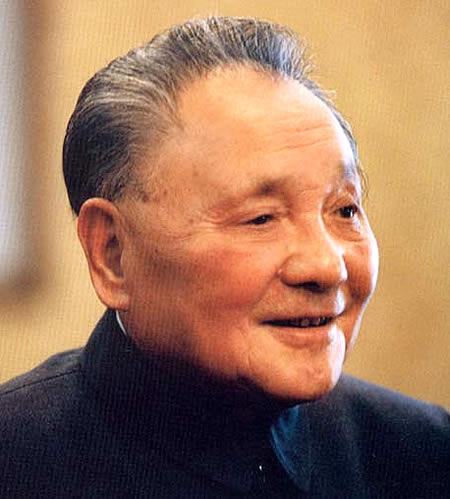
Deng Xiaoping (Teng Hsiao-p’ing)

Deng Xiaoping
Deng Xiaoping

Deng Xiaoping was born on August 22, 1904. As leader of the Chinese Communist Party (CCP), Deng was not officially the leader of China but acted as such during the late 1970s until his death. Deng’s legacy was the creation of a Chinese form of socialism with limited economic liberalization.

Many Communist hard-liners, however, argued that Deng represented a threat and the potential of a return to capitalism. The divided opinion within the CCP with regard to Deng would be a pattern throughout his career. It was under Deng’s “second generation” of leadership that China became one of the fastest-growing world economies.

Deng left China in 1920 to work and study in France. He quickly gravitated to many of his seniors on the trip—including Zhou Enlai (Chou En-lai). Deng’s studies focused on the study of Marxism; in 1922 he joined the Communist Party of Chinese Youth in Europe. By 1924 Deng became a member of the Chinese Communist Party. He returned to China in 1929, led the failed uprising in the Guangxi (Kwangsi) province, then fled to Jiangxi (Kiangsi) Province.


Deng participated in the Long March (1934–35) and guerrilla campaigns against Japan in World War II as well as in the civil war against the Kuomintang. He became mayor and political commissar of the city of Chongqing (Chungking). Mao Zedong (Mao Tse-tung) promoted him to several prominent posts. Mao’s 1957 Anti-Rightist Campaign offered Deng the opportunity to work closely with another Communist leader, Liu Shaoqi (Liu Shao-chi).

As a result of Mao’s Great Leap Forward and the economic disaster that followed, Deng and Shaoqi took over control of the CCP and government and implemented a number of less radical and pragmatic policies. The Cultural Revolution, begun by Mao in 1966, dealt a major blow to Deng’s career, and he was disgraced.

By 1974, Chinese premier Zhou Enlai was able to bring Deng back to power, taking over as first deputy premier in charge of running the day-to-day affairs. However, the radical Gang of Four, committed to the ideals of the Cultural Revolution, viewed Deng as a significant threat and were able to purge him once again from his positions. Deng’s next opportunity came with Mao’s death in 1976, and he quickly emerged as Mao’s successor.

After 1978 Deng implemented policies that improved relations with the West, traveling to Washington in 1979 to meet President Jimmy Carter. Relations with Japan improved as well. In 1984 China signed an agreement with Great Britain for the return of Hong Kong to China in 1997. China promised not to interfere with Hong Kong’s capitalist system for 50 years.

Deng implemented the Four Modernizations Program in agriculture, industry, science and technology, and the military. The goal of the modernization program was to create a more modern Chinese economy. Under him China encouraged direct foreign investment and created special economic zones.

The Tiananmen Square massacre is the most controversial of all Deng’s policy decisions. Mass student demonstrations in favor of democratic reforms were met with a violent military crackdown ordered by Deng and his senior associates that resulted in thousands of deaths in Beijing and dozens of other cities in China. It was followed by widespread repression, which stained his career.

Falun Gong

Falun Gong
Falun Gong

Falun Gong is a system of meditation exercises, termed qigong, introduced by Li Hongzhi in 1992. Falun Gong, translated as Practice of the Wheel of Law, grew quickly after its public introduction and is also known as Falun Dafa. In 1999 the Chinese government suppressed Falun Gong in response to hugely growing numbers and large peaceful demonstrations by Falun Gong practitioners.

In 1992 Li Hongzhi introduced Falun Gong at the Fifth Middle School in China. A system of qigong, Falun Gong is a cultivation practice associated with Buddhism. The foundation of Falun Gong is dharma, the doctrine and discipline of Buddhism. The Falun Gong core principles are truthfulness, compassion, and forbearance. Qigong systems teach breathing techniques and meditation.

In Falun Gong, practitioners are required to enforce strict meditation and must abide by truth, compassion, and endurance in all of their actions. Falun Gong, using evidence they believe does not fit into modern anthropology, teaches that humankind has endured several cycles of civilization.


Its teachings emphasize not belief but rational understanding. To pray or hope for things is considered futile action. Lust, homosexuality, and other practices considered of low morals in Falun Gong are believed to hinder the cultivation process.

According to its beliefs there are five important sets of exercises that include meditation: four standing exercises and one sitting exercise that strengthen the mind and the body. It also believes that karma is the cause of disease and that only by letting go of earthly attachments can one prevent and cure disease. Additionally, in Falun Gong the Wheel of Law (the Falun) must be installed in the abdomen through meditation. Once installed, this Falun turns continuously.

By the late 1990s, Falun Gong, spread by the Internet, had gained followers all over the world. Controversy over its beliefs led to protests by believers in 1998, during which some practitioners were arrested. According to Falun Gong reports, the police beat some of the protesters. On July 20, 1999, the Chinese government began attempts to suppress the movement, concerned about its growth.

Books and Web sites related to Falun Gong were suppressed, and the movement was declared illegal in China. However, the movement continues to claim followers in more than 80 countries, where governmental reactions range from acceptance to suspicion. One estimate projects their membership to be around 70 million people.

Gang of Four and Jiang Qing

Gang of Four and Jiang Qing

The epithet “Gang of Four” was Mao Zedong’s (Mao Tse-tung) name for his wife, Jiang Qing, and her three lieutenants, Yao Wenyuan (Yao Wen-yuan), Zhang Chunqiao (Chang Ch’un-ch’iao), and Wang Hongwen (Wang Hung-wen) in 1976; the four rose to power during the Great Proletarian Cultural Revolution (1966–76).

Jiang had hoped to succeed her husband as leader of the Chinese Communist Party when he died, with the assistance of her three confederates. Instead, they fell from power within a month of his death, were tried for high crimes in 1980, and were convicted.

Jiang Qing (1913–91) was an actress in Shanghai before she went to Yan’an (Yenan). She became Mao’s secretary, then his wife, over the objection of his colleagues, who reputedly made him promise to keep her out of politics for at least 20 years. Largely sidelined from running the party since 1960 as a result of the failed Great Leap Forward, Mao promoted her to great prominence in 1966 to help him recapture power.


Together they unleashed the Cultural Revolution and empowered the youthful Red Guards to inflict a reign of terror that eliminated Mao’s enemies. Jiang Qing took control of the media and banned all entertainment except for the eight “model operas” that she authorized.

However, before his death in September 1976, Mao appointed Hua Guofeng (Hua Kuo-feng), minister of public security and acting premier, to be his successor. Jiang then planned to mount a coup and assassinate the senior party leaders with the aid of her lieutenants and the militia, which was loyal to them.

But they were preempted by Hua, who had the support of the senior party and military leaders. Hua invited the Gang of Four to attend an emergency meeting of the Politburo (the supreme council of the Communist Party) at its head-quarters at midnight on October 5.

Gang of Four trial
Gang of Four trial

Zhang, Wang, and Yao fell into the trap and were arrested as they arrived for the meeting; Jiang was captured while still in bed. None of their supporters rose to their aid. This event was called the Smashing of the Gang of Four.

Nevertheless it took four years before the Gang of Four was brought to trial for crimes they had committed against the state and people because of the difficulty of assessing Mao’s role in what transpired during the Cultural Revolution.

In November 1980 a special court charged them with framing and persecuting party and government leaders, torturing and killing more than 34,750 people, and plotting an armed uprising in Shanghai after Mao’s death. Although the others admitted guilt, Jiang remained defiant, claiming that she had acted as Mao’s dog, doing his bidding.

The trial lasted two months and resulted in death sentences for Jiang and Zhang, with a two-year suspended execution. Wang was sentenced to life and Yao received 20 years. Some sources say that Jiang committed suicide in jail in 1991. Wang died in 1992, Zhang died in 2005, and Yao died in 2006.

Great Leap Forward in China (1958 – 1961)

Great leap forward poster

The People’s Republic of China (PRC) followed the Soviet Union’s model of planned economy on the socialist model. The success of the First Five-Year Plan (1953–57), undertaken with Soviet financial and technical aid, prompted the government to announce a more ambitious Second Five-Year Plan for 1958–62 that called for a 75 percent increase in industrial and agricultural production.

This was not enough for party leader Mao Zedong (Mao Tse-tung), who proclaimed a “Great Leap Forward” in February 1958 with the goal of passing Great Britain in industrial production by 1972. It mandated an average 18 percent increase in steel, electricity, and coal production for that year. This was only the beginning of a series of escalating and totally unattainable goals for production.

Mao called on the Chinese people to “walk on two legs,” that is, to use modern and sophisticated plants built with Soviet aid to make steel, along with primitive “backyard” furnaces manned by millions of untrained workers.


By late 1958, 600,000 backyard furnaces had been built throughout China that smelted pots, pans, and farm implements, with wood from forests as fuel, and that produced millions of tons of unusable metal in order to fulfill their quotas and avoid punishment.

To mobilize all the available labor force and to complete the socialist transformation of the people, more than 500 million peasants, or more than 98 percent of the rural population, were organized into 26,000 People’s Communes that controlled all aspects of their lives.

In addition, some city people were organized military fashion into urban communes. Afraid of failure to realize Mao’s fantastic expectations, local Communist bosses competed with one another to announce overachievement of quotas and goals, which allowed the government to announce at the end of 1958 that industrial production for that year had exceeded that of 1957 by 65 percent.

backyard furnaces
backyard furnaces

In launching the Great Leap Forward Mao was also motivated by his disapproval of Soviet leader Nikita Khrushchev, whom Mao castigated as “revisionist” for giving incentives to improve productivity in Soviet agriculture. He boasted that he had found a shortcut, through the People’s Communes, to reach the ultimate Marxist utopia ahead of the Soviet Union and thus the right to lead the world communist movement.

The Soviet Union, however, firmly rejected Mao’s claims when Khrushchev declared that “society cannot leap from capitalism to communism.” The debate over the validity of the Great Leap Forward widened the split in the international communist movement and contributed to worsening relations between China and the Soviet Union.

In reality the Great Leap Forward brought unprecedented disaster to the Chinese people. By 1959 it was no longer possible for the government to deny that the economy had been crippled. The people were exhausted and demoralized, and famine stalked the land.

Economists estimated that the economy had declined by $66 billion, and demographers concluded that more than 30 million people had died of starvation in the Mao-made famine, the worst in world history.

At the Lushan Conference of communist leaders Mao had to admit his folly, stepped down from chairmanship of the PRC, and let others who had not lost touch with reality—called pragmatists—run the country to bring it back from ruin.